Indie iOS App Marketing Strategy 2026: An Honest Playbook
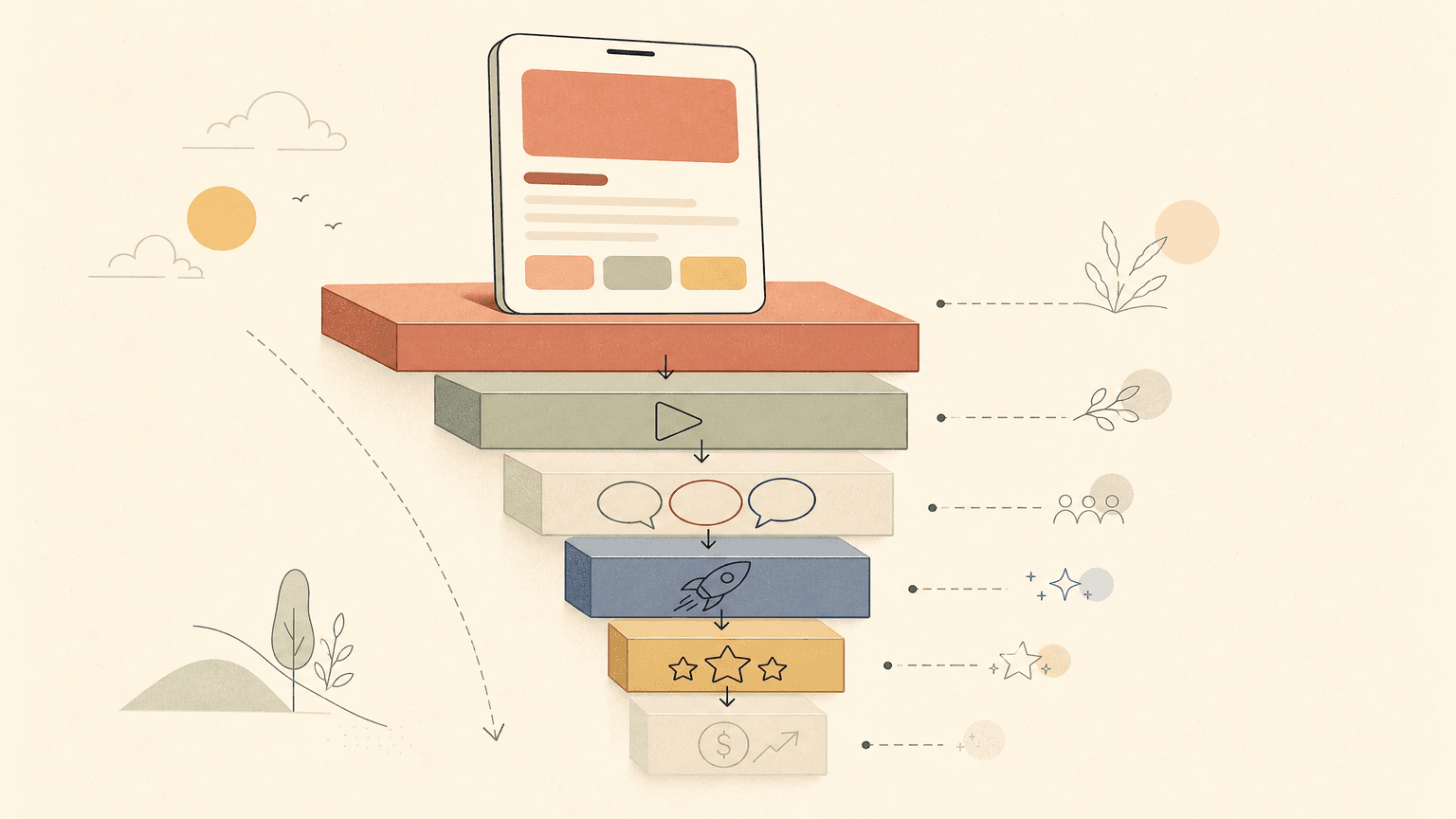
TL;DR. There is no silver bullet in 2026, and paid installs no longer carry an indie app. Rank your channels by realistic ROI on a near-zero budget and work them in order: a tight ASO foundation (around 60% of App Store downloads come from search, per Apple), benefit-led screenshots that win the 3-second listing decision, short-form organic video, communities and build-in-public, a concentrated launch window, a reviews-and-retention flywheel, and only then paid. Optimize for retained, paying users, not raw installs, because the global median Day-30 retention is about 5.4%.
Last updated: 2026-06-22.
Disclosure. We make ScreenFast, an AI App Store screenshot generator. It is relevant to exactly one step below (store screenshots), and we say so plainly and also name where it does not fit. Every Apple figure is cited to developer.apple.com and every statistic to its named source.
The honest reality of indie iOS marketing in 2026
Start here, because most "how to market your app" content will not. The one real-practitioner result on page one is an Apple Developer Forums thread. In it, indie devs report that paid installs, influencer promos, push, and even organic growth are all slowing in 2026. The only consensus answer was non-tactical: quality product, clear value, marketable and different. That is the honest baseline. Anyone promising a single growth hack is selling something.
Two facts set the stakes. First, distribution is the bottleneck, not code. Indie developer Roman Koch's 2025 recap (Medium, January 2026) reports shipping 8 apps for $1,464 total after Apple's fees, and names his biggest weakness directly: "Marketing beats code. Every time."
Second, the market is brutally concentrated. Adapty's State of In-App Subscriptions 2026 covered 16,000+ apps and over $3B in tracked revenue. It found the top 10% of apps capture about 94.5% of all subscription revenue. And 8 in 10 new apps never pass $10K. So raw installs are a vanity metric, especially when global median Day-30 retention is about 5.4% (Albato, 2026). The goal is retained, paying users, not a download spike.
This playbook is ranked for that reality.
The honest channel priority order (ranked by ROI on a near-zero budget)
If you have $0 and limited hours, do them in this order. Each one compounds before the next becomes worth your time.
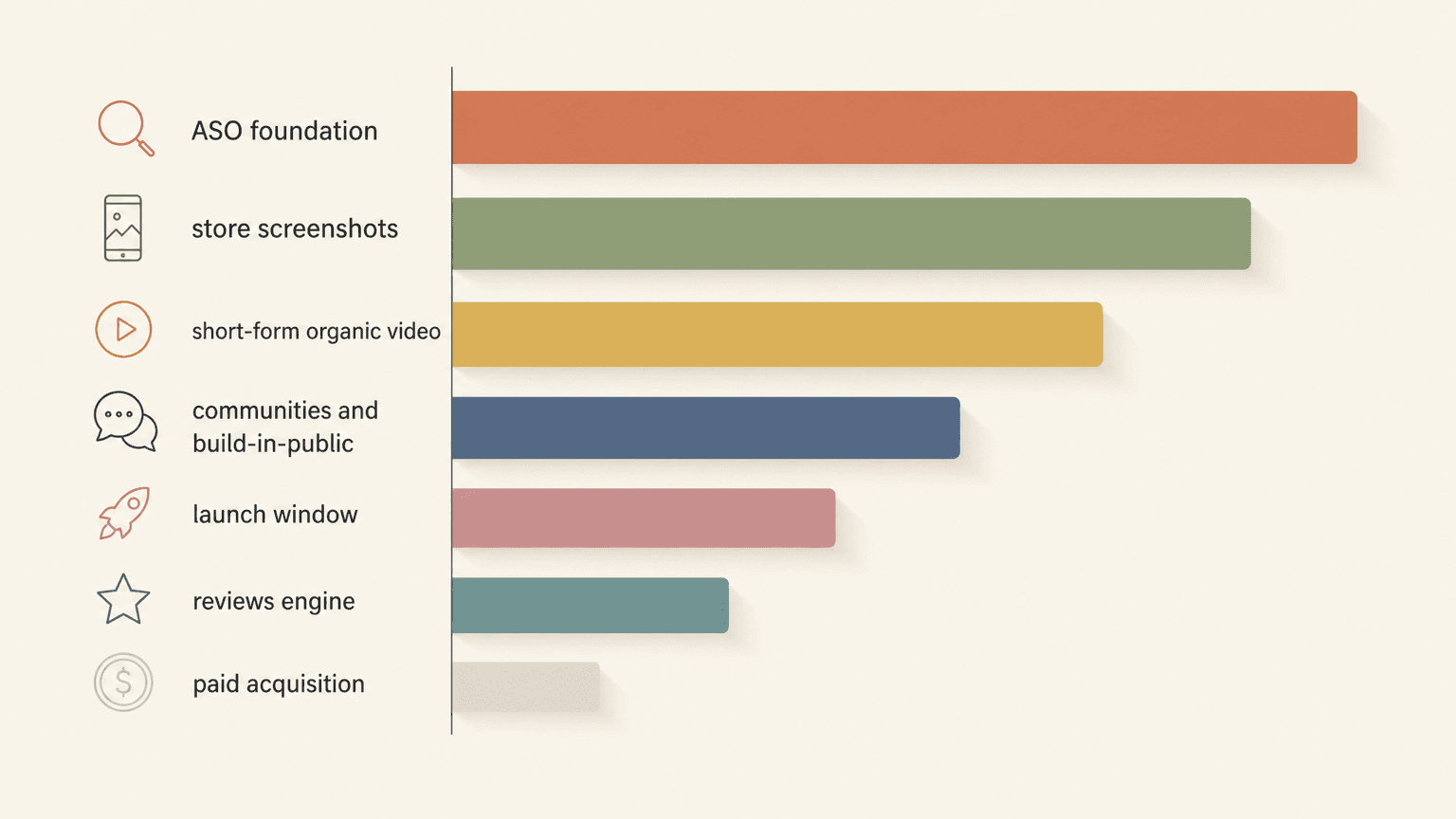
| Channel | Realistic cost | Time to impact | Near-zero-budget ROI |
|---|---|---|---|
| ASO foundation (title, subtitle, keywords) | $0 (your time) | 4 to 8 weeks | Highest, compounds, ~60% of discovery |
| Store screenshots (benefit-led) | $0 DIY or ~$9.99 with a generator | Immediate on listing | Very high, first screen drives the decision |
| Short-form organic video (TikTok/Reels) | $0 (your time) | Days to weeks | High but volatile |
| Communities + build-in-public | $0 (your time) | Ongoing | High for the right audience |
| Launch window (Product Hunt, HN, deal-trackers) | $0 plus optional price drop | One spike | Medium, the spike fades |
| Paid acquisition (Apple Search Ads, Meta) | A few hundred dollars minimum | ~50 conversions / 7 days to stabilize | Low until the funnel converts |
ASO sits first for a reason. Roughly 60% of App Store downloads come directly from search queries (Apple's figure, cited via MobileAction). About half of those searches are generic, non-brand terms you can actually rank for. The catch is patience: ASO takes 4 to 8 weeks to show meaningful movement.
Paid is ranked last because it is not actually zero-budget. Meta needs about 50 conversions inside a 7-day window before its algorithm stabilizes. That means a few hundred dollars minimum. Apple Search Ads shows a high tap-to-install rate (SplitMetrics put 2024 search-results conversion near 67%). But that is conversion on high-intent traffic you are paying for, not free discovery. Paid amplifies a listing that already converts. It does not fix one that does not.
Before you ship: the store-listing assets that do the heavy lifting
Your listing is the conversion surface every channel above feeds into. Users decide to install or move on within about 3 seconds of seeing it, and the first screenshot carries most of the conversion weight (per AppLaunchFlow). Get these right before you spend a single hour on promotion.
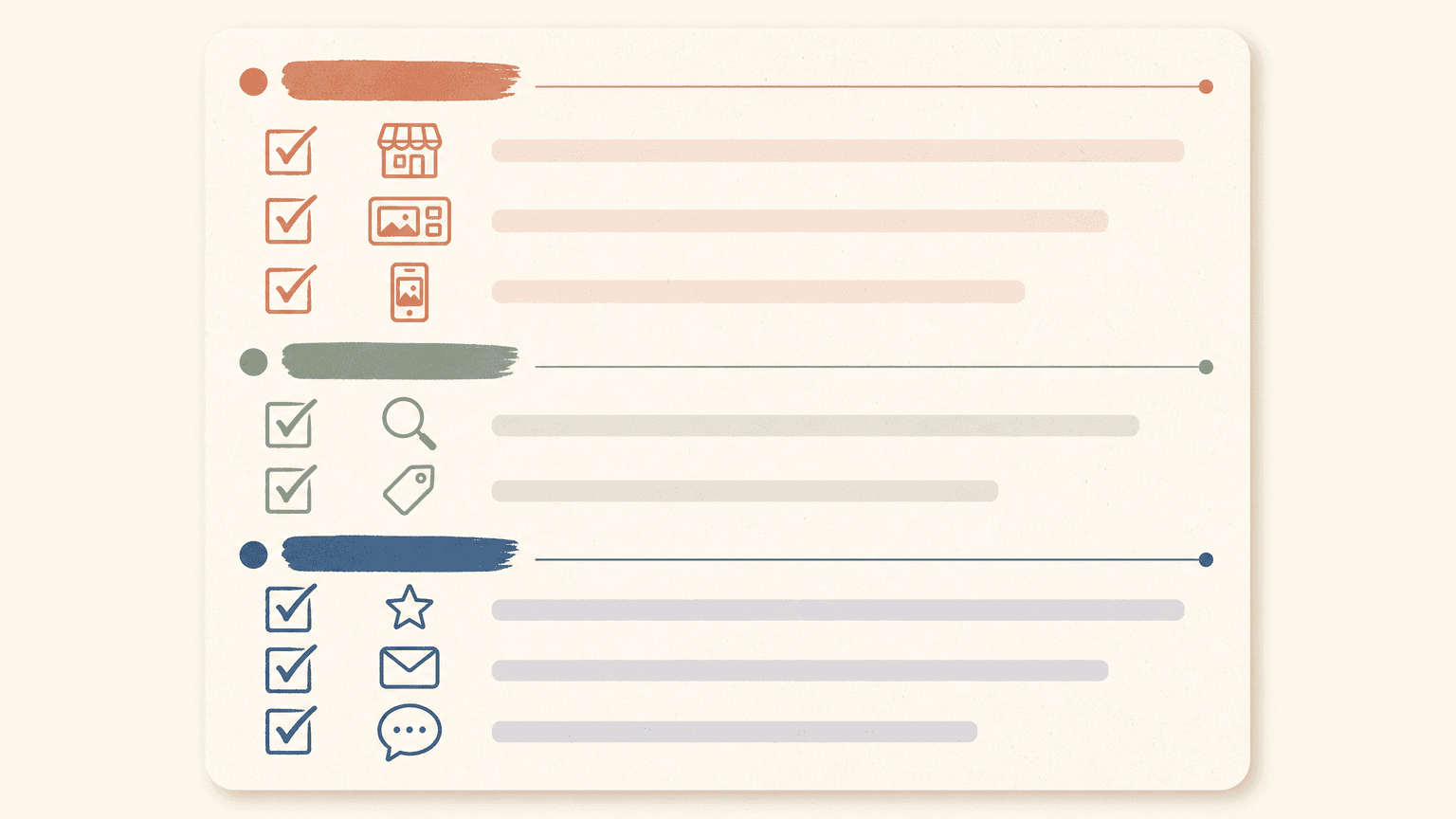
- Title and subtitle carry your highest-value keywords. The title is capped at 30 characters, so lead with the benefit plus your strongest term.
- Screenshots are a conversion-rate-optimization asset, not decoration. Lead with a benefit on a real UI shot, answer "but how" on the second, and use the third for social proof. Apple accepts a single 1290x2796 master (iPhone 6.9 inch) and auto-scales it to smaller iPhone classes; confirm current requirements on developer.apple.com because the tiers change.
- App icon is the one asset shown in search results next to your title. Keep it one strong shape that reads at 40 pixels.
Disclosure, because it is relevant exactly here: we make ScreenFast, an AI App Store screenshot generator. It starts with a free audit of your App Store URL or uploaded prelaunch screens, then generates 10 design directions after the $9.99 one-time checkout. Its honest boundary: it makes static screenshots, not App Preview videos, and reliable in-design text edits are manual, so write your captions yourself and review every generated detail. For everything else on the pre-flight list (metadata, TestFlight, first reviews), use the pre-launch checklist, and treat screenshots as a CRO asset you keep testing (see the App Store conversion benchmarks).
Organic reach that compounds: video, communities, and build-in-public
Once the listing converts, the cheapest scalable reach is organic.
Short-form video (TikTok, Instagram Reels) sits just below the listing in priority. One good clip can bring thousands of users, and you can test concepts organically before paying to boost any of them. The honest caveat is volatility: most clips do nothing, so treat it as cheap lottery tickets, not a reliable channel.
Communities and build-in-public are the indie advantage a big-budget competitor cannot copy. Reddit, Discord, Indie Hackers, and X reward a real founder story over a polished ad. For a technical audience, Hacker News can outperform Product Hunt. In one widely cited "Ask HN" thread, a Show HN post drove about 300 downloads in a day, more than the poster got elsewhere. Indie Hackers argued in September 2025 that the common indie trap is leaning too hard on paid ads while overlooking ASO and community.
This is also where an honest, experience-first voice beats production budget. Indie developer Shawn Hickman (creator of the Sofa app) walks through exactly this in his zero-budget video:

The launch window: how to spend your one spike of attention
A launch is a concentrated window, not a single day. The point is density: a spike of relevant downloads signals quality to the App Store algorithm and to humans browsing it. As AppLaunchFlow puts it, "most launches underperform not because the app is weak, but because the strategy is improvised."
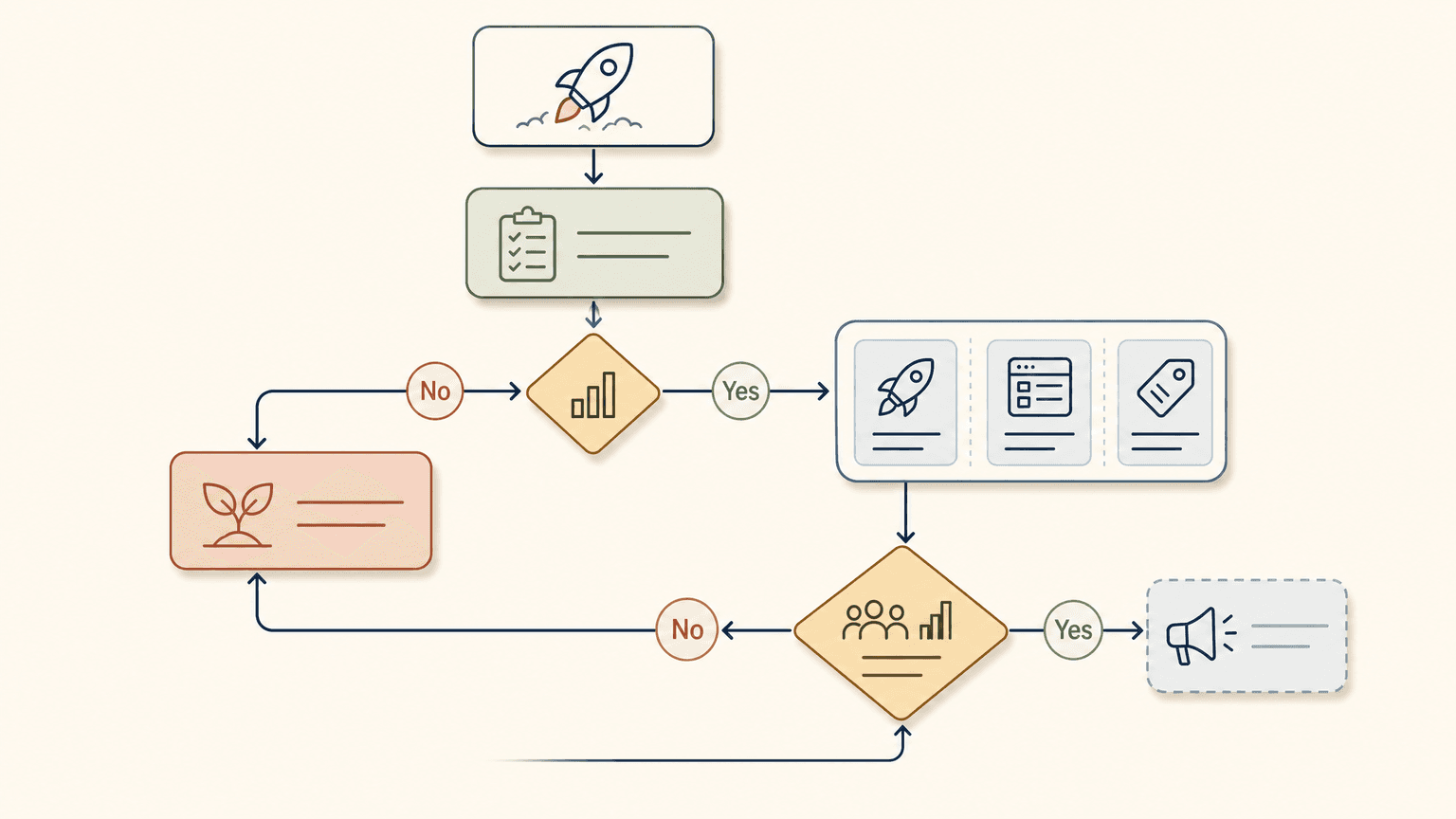
Sequence the spike so the channels reinforce each other. A temporary price drop or a free-for-launch promo can trigger deal-trackers at the same time you post to Product Hunt and Hacker News, concentrating attention into one window instead of scattering it.
Apple gives you tooling to capture that traffic. You can publish up to 70 Custom Product Pages, each with its own screenshots, promo text, and unique URL for ads and social. Apple reports developers see a 2.5 percentage-point lift on average when sending people to a custom product page. That is a 156% increase over the 1.6% default-page average (developer.apple.com). Pair that with Product Page Optimization to A/B test up to three alternate listings. The spike fades within days. The compounding channels are what sustain installs after week one.
Reviews, retention, and the post-launch flywheel
After launch, two levers beat chasing new installs.
First, a reviews engine. Prompt for ratings at genuine value moments using Apple's native prompt, and reply to negative reviews within 48 hours. The 4.0-star line is the consideration threshold most browsers apply before they even read your listing.
Second, retention and monetization design. These move revenue more than acquisition tweaks do. RevenueCat's State of Subscription Apps 2026 found hard paywalls convert about 5x better than freemium at the download-to-paid level (10.7% vs 2.1% median), with nearly identical year-one retention. It also found trials of 17 or more days convert about 70% better than short trials (42.5% vs 25.5% trial-to-paid), even as developers drift toward 3-day trials. The order of operations is clear: keep and convert the users you already earned before paying for more.
Then make the listing a living asset. Quarterly A/B testing of screenshots and pricing can lift conversion 20 to 30% versus annual-only updates (Albato), and the A/B testing guide shows how to run it on Apple's free PPO. A double-sided, one-tap referral loop and a simple email list extend reach for free.
Localization as a distribution channel
Localization is the most underused distribution lever for indies, precisely because most ranking advice is US and English-centric. That leaves non-English markets relatively open.
There are two distinct jobs. The store text metadata (title, subtitle, keywords) is its own ASO task per language. The screenshot images carry the visual pitch and are a separate job. ScreenFast localizes the screenshot images into up to 16 languages, with automatic right-to-left handling for Arabic and Hebrew. It does not translate your App Store text metadata, so handle that side separately. The localization guide covers the full flow.
Prioritize by your category's actual market size rather than localizing all 16 at once. The 4-to-8-week ASO timeline applies per market. And a localized listing is a CRO test like any other: validate that it lifts that market's conversion before committing further.
How we tested
Every Apple figure here (the ~60% from search, Custom Product Pages, the +2.5 point custom-page lift, the screenshot specs) is cited to developer.apple.com. Industry statistics are attributed to their named source: RevenueCat's State of Subscription Apps 2026, Adapty's State of In-App Subscriptions 2026, SplitMetrics, and Albato. Vendor figures carry a built-in incentive, so we flag them as directional rather than gospel; Apple's "60% of downloads from search" is the best-attributed single stat.
The channel priority order is synthesized from where multiple indie-focused sources converge, not lifted from any one page, because none of the top-ranking articles publishes a single honest, ROI-ranked list for a true $0 budget. Practitioner signals (Roman Koch's recap, the Show HN ~300-downloads-in-a-day report, Shawn Hickman's video) are small-sample anecdotes used as illustration, not benchmarks. Reddit was not directly retrievable through our tooling, so we did not quote it.
Disclosure again: ScreenFast is our own product. We mention it only at the one step where it fits (store screenshots) and explicitly name where it does not (videos, text metadata, paid acquisition, analytics).
Frequently asked questions
How long does ASO take to show results for an indie iOS app?
About 4 to 8 weeks to show meaningful movement (MobileAction, AppDrift). ASO compounds, but it is slow, which is exactly why it should be the first thing you set up rather than the last.
How much should an indie developer budget for app marketing in 2026?
A commonly cited rule of thumb is 10 to 20% of revenue (AppGrowthStudio). For a true $0 budget, the honest answer is to spend time, not money: ASO, screenshots, organic video, and community first, and only move to paid once your listing already converts and you can fund the ~50-conversion learning window Meta needs.
What are the most important KPIs to track?
Conversion rate (impressions to installs), Day-1 and Day-30 retention, and trial-to-paid, not raw download count. With median Day-30 retention near 5.4%, retained and paying users are the only numbers that predict revenue.
How often should I update my App Store listing?
Treat it as a living asset and A/B test quarterly. Quarterly testing of screenshots and pricing can lift conversion 20 to 30% versus annual-only updates (Albato).
Can indie developers actually compete with big companies in App Store rankings?
In organic search, yes, because about half of App Store searches are generic and ASO is the equalizer. In paid auctions for high-value head terms, usually no. Compete where money is not the deciding factor: long-tail keywords, a sharper listing, community, and localization.
What realistic download numbers can I expect from low-cost marketing?
Anchor to the median, not the outliers. Eight in 10 apps never pass $10K in revenue (Adapty 2026). Indie cost-per-install runs roughly $0.10 to $0.80 and a healthy LTV:CAC is about 3:1 (IndieAppSanta), but those only matter once retention and conversion are working.
Should I localize my listing if my app is only in English?
Often yes, because non-English markets are less contested. Start with the store text metadata for one or two high-fit markets, localize the screenshot images to match, and validate the conversion lift before expanding.