TikTok Marketing for Indie Apps: 30-Day Plan (2026)
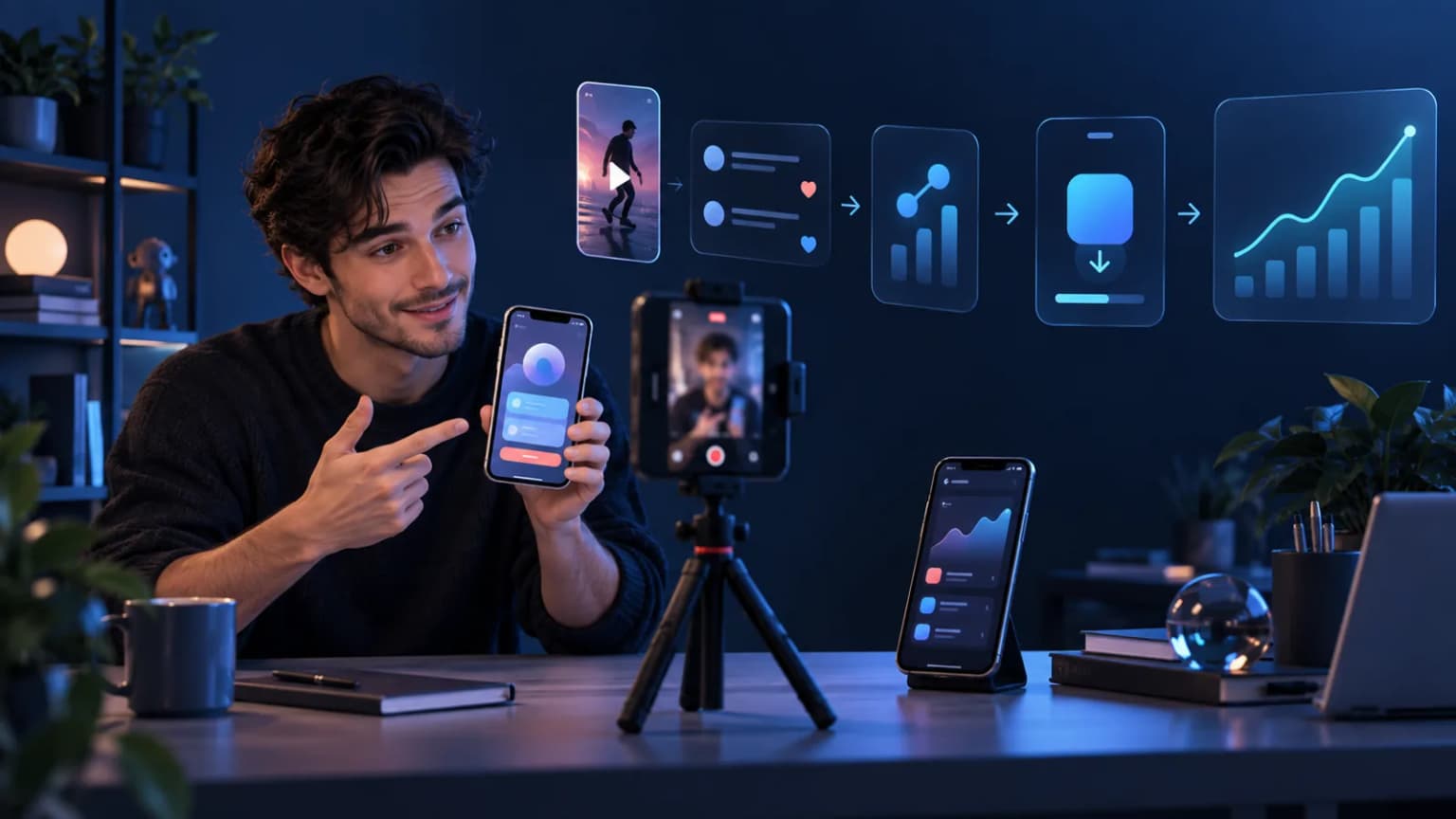
TL;DR. Treat TikTok marketing for an indie app as a 30-day experiment, not a promise of virality. Start with organic videos that demonstrate one problem and one outcome. Track creative signals, App Store campaign traffic, downloads, activation, and revenue as separate steps. Pay to amplify a proven concept only after the listing and product convert. Do not plan around universal posting frequencies, CPI claims, or supposed algorithm tricks.
Last updated: September 24, 2026.
Disclosure. We make ScreenFast, an App Store screenshot generator. It can improve the product page a TikTok visitor reaches, but it does not create videos, manage TikTok campaigns, or guarantee installs.
The 30-day indie app marketing plan
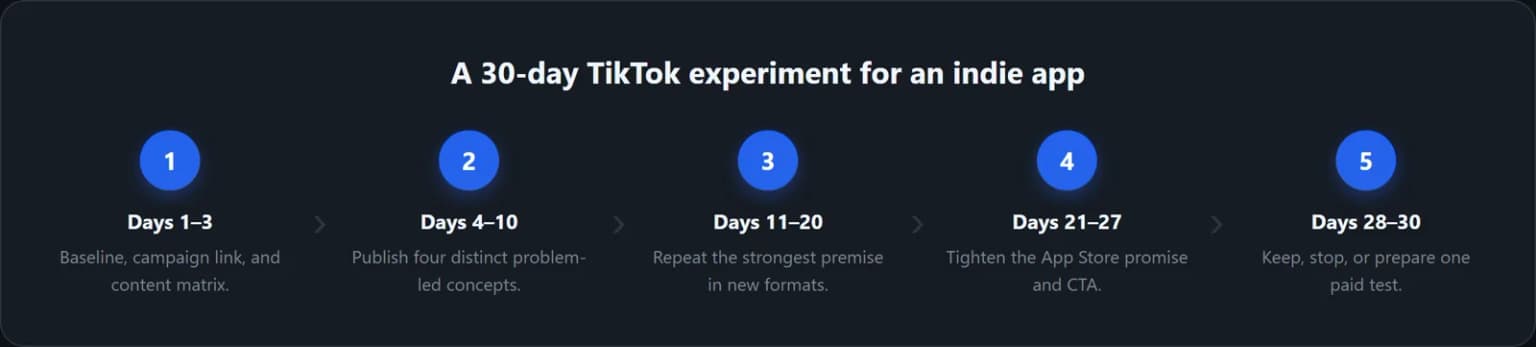
| Period | Goal | Output |
|---|---|---|
| Days 1-3 | Make the experiment measurable | Baseline, campaign link, content matrix |
| Days 4-10 | Test different problems and formats | Four distinct posts |
| Days 11-20 | Repeat the strongest premise | Three to five meaningful variants |
| Days 21-27 | Align the tap with the App Store page | Listing and CTA review |
| Days 28-30 | Decide what deserves another month | Keep, stop, or one paid test |
This schedule is a production and decision framework. TikTok does not guarantee distribution after a set number of posts. Your app, audience, territory, creative, and account history will affect what happens.
Days 1-3: make the experiment measurable
Write one business objective before recording anything. Choose a qualified outcome, such as first-time downloads from a campaign, activated users, trial starts, or purchases. Views are a creative diagnostic, not the final result.
Save a baseline for the seven days before the experiment:
- App Store impressions, unique product page views, first-time downloads, and conversion rate.
- App referrer and web referrer data where privacy thresholds allow it.
- Activation, retention, trial starts, purchases, and proceeds inside the product.
- The current icon, first three screenshots, subtitle, pricing, and onboarding promise.
Create an App Store campaign link for this experiment if the Campaigns feature is available for the app. Apple campaign links use a campaign token and provider token to connect a marketing link with product page views, downloads, usage, sales, and subscriptions. A campaign appears only after enough data is available. Apple's current campaign-link documentation says metrics need at least five attributed users in the selected range and can take more than a day to appear.
Use the tagged link anywhere TikTok allows a clickable destination. Keep a separate token for organic TikTok, paid TikTok, and creator partnerships. If every channel uses the same raw App Store URL, later attribution becomes weaker.
Finally, build a small content matrix. Cross three audience problems with three formats. For example:
| Problem | Demo | Story | Comparison |
|---|---|---|---|
| Task takes too long | Complete it in one take | Why you built the shortcut | Old workflow vs app |
| User does not know where to start | First-use walkthrough | A beginner mistake | Blank state vs completed result |
| Existing tool feels complex | One-feature screen recording | What you removed | Complex flow vs focused flow |
Nine ideas are enough to start. A huge content calendar delays contact with real feedback.
Days 4-10: test four distinct creative concepts
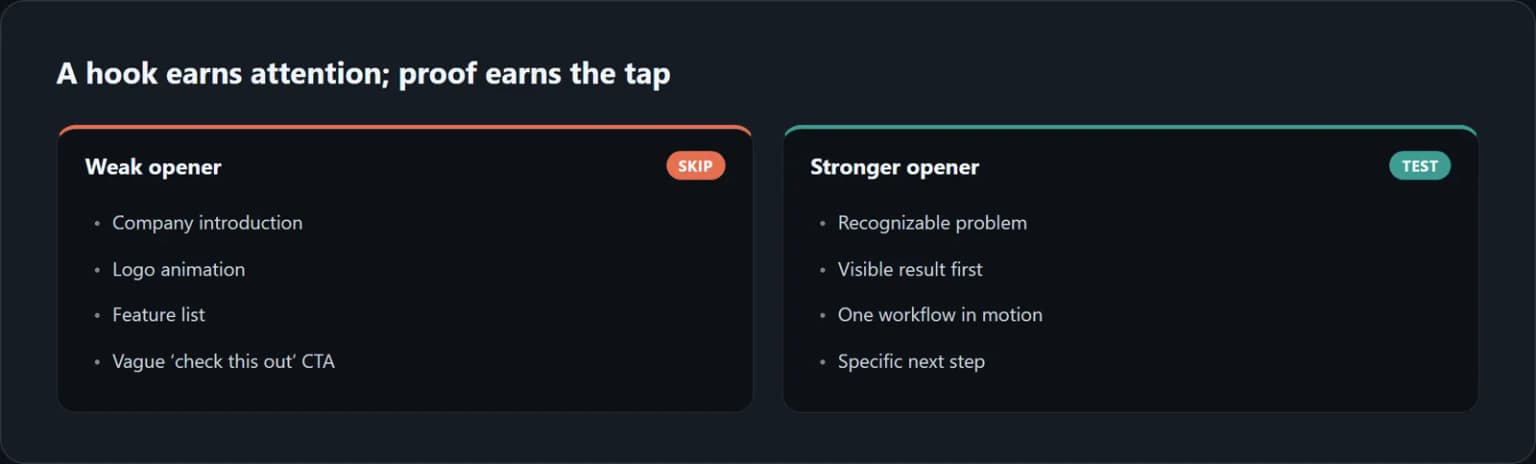
Publish four videos that answer different questions. Do not make four edits of the same founder introduction.
Useful concepts for an indie app include:
- Result first. Show the completed outcome, then replay the three steps that created it.
- Pain to workflow. Name a recognizable frustration and demonstrate one path through the app.
- Build decision. Explain why you removed, simplified, or redesigned one feature.
- Comment response. Turn a real question or objection into a video demonstration.
Open with the problem, result, or surprising product moment. Skip the logo animation and company history. TikTok's own creative guidance emphasizes the opening seconds, mobile-first vertical video, sound, and content that feels native to the platform. It describes these as guidelines rather than a guaranteed formula. Use the TikTok Creative Center guidance as a source of formats, then adapt them to the product instead of copying a trend without context.
Make the proof visible. If the app removes a background, show the before and after. If it schedules a workout, show the plan appear. If it scans a receipt, show the structured result. A person should understand the value with the sound off, while voice and sound should add context when enabled.
End with one specific next step. "Try the iPhone app" is clearer than "link in bio" when the viewer has not yet heard what the app does. Match the CTA to the destination and account capabilities available in the viewer's market.
Three short scripts to film with one app
Use the same real receipt-scanning utility for three different viewer questions. These are production examples, not videos we published or tested. First, the "result first" version opens on the clean expense row, then shows a real receipt capture and the app's actual output. Second, the "pain to workflow" version starts with an unsorted pile of receipts and walks through one genuine scan. Third, a "question response" version answers a real objection, such as whether the app can correct a merchant name, by showing the current editing flow if that feature exists.
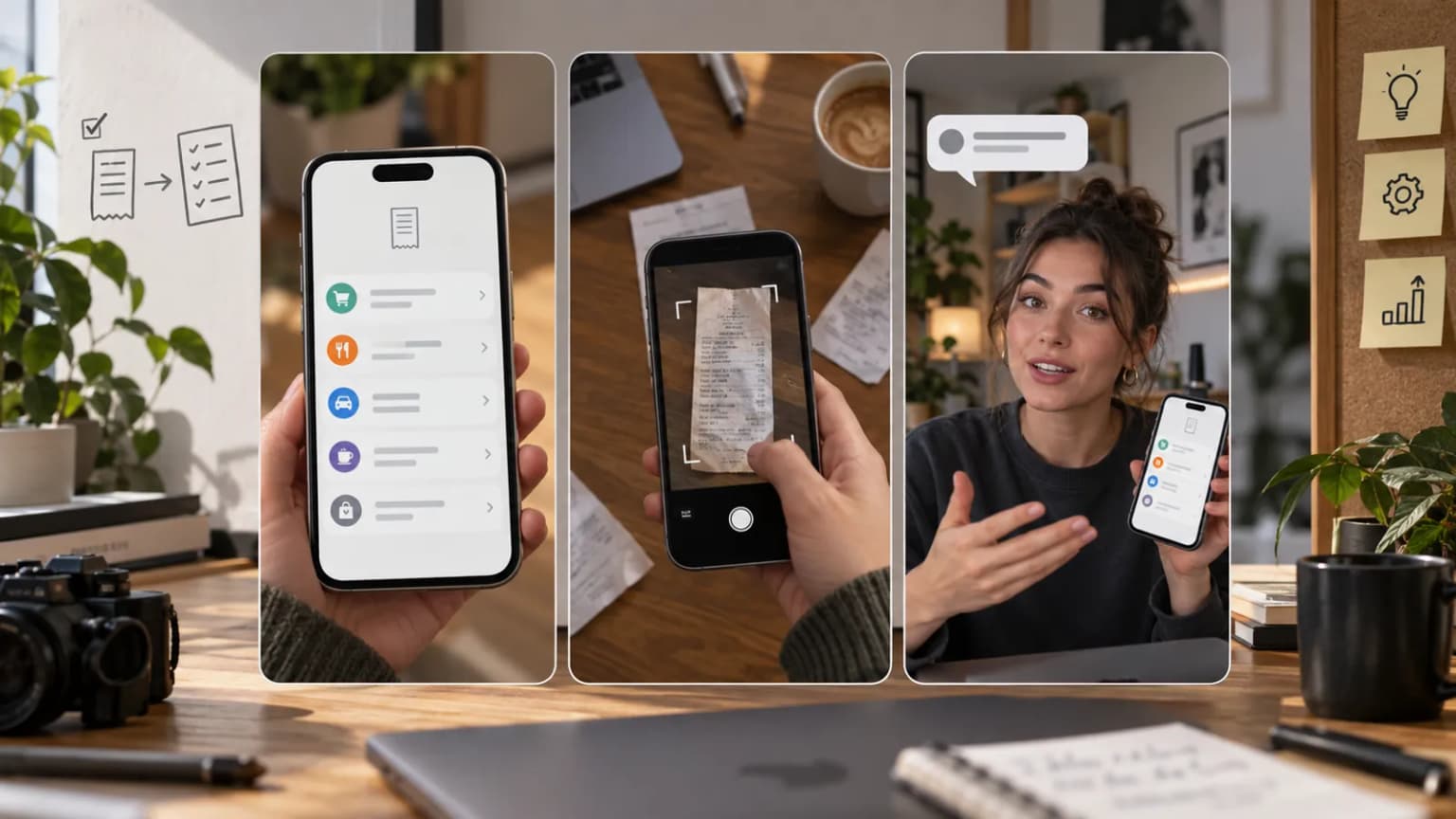
Draft each video in three lines before filming:
| Beat | Result-first version | Question-response version |
|---|---|---|
| Opening | Show the cleaned result | State the viewer's exact question |
| Proof | Replay the real capture | Demonstrate the real control or limitation |
| Next step | Invite the right viewer to try the app | Point to the matching app page or help answer |
Do not claim a scan is instant if the product needs a review step. Do not imply a feature exists because a prototype or editor can draw it. Keep the first App Store screenshot aligned with the premise people tapped for, while avoiding a second copy of the whole video on the listing. These examples give the four-concept test something concrete to film; they do not prescribe a universal video length or posting schedule.
Days 11-20: repeat the premise, not the exact video
Choose the one or two concepts that produced the strongest combination of attention and qualified action. Then create variations around the premise.
Good variations change one meaningful dimension:
- the audience example;
- the opening problem;
- the visible outcome;
- voiceover versus text-led explanation;
- founder demonstration versus customer-style demonstration;
- fifteen seconds versus a fuller walkthrough.
Do not declare a winner from the post with the most views. A broad joke can reach many people who will never use the app. Compare watch time, completion, saves, comments that indicate intent, profile actions, campaign traffic, and downstream product quality.
Use comments as research. Questions such as "Does it work offline?", "Is there an iPad version?", or "Can it export PDF?" reveal the proof missing from the current creative or App Store page. Answer the question truthfully and use the next video to show the evidence.
This is also the point to decide whether TikTok fits the audience. A professional utility can still work, but the format and buying context may produce weak qualified demand. Stopping a poor channel after a measured test is a good result.
Days 21-27: fix the path from tap to install
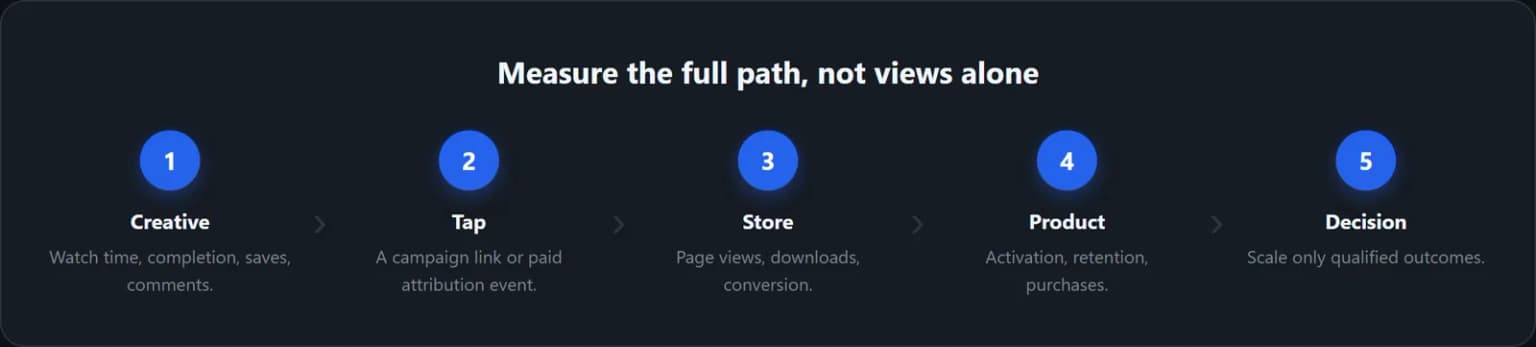
A video and an App Store page form one promise. If the video demonstrates a fast invoice scan but the first screenshot leads with account settings, the user must rediscover why they tapped.
Compare the winning premise with the live listing:
- Does the icon and title make the product recognizable?
- Does screenshot one repeat the outcome without copying the video word for word?
- Does screenshot two show real interface proof?
- Is the price or subscription model understandable?
- Does onboarding deliver the demonstrated result quickly?
- Does the listing match the territory and language of the audience?
Run the App Store listing optimization checklist before changing assets. If the opening sequence is weak, the guide to the first and second App Store screenshot gives each frame a separate job.
Measure by source. Apple's Acquisition dashboard distinguishes App Store search, browse, app referrers, web referrers, and campaign links. It can also connect a recorded download source with later usage, sales, and subscription data. Review the current App Store acquisition documentation before combining unlike sources into one conversion rate.
Low volume can hide source data because Apple applies privacy thresholds. Missing detail is not proof that the channel produced no users. Keep the TikTok dates, post URLs, campaign token, listing changes, and product releases in one log so you can interpret the remaining evidence.
Days 28-30: decide whether to keep, stop, or pay
At the end of the month, choose one of three actions.
Keep organic. Continue when you can produce the format sustainably and it drives qualified traffic or useful audience research. Write the next month's test around the strongest premise, not around a higher posting quota.
Stop or pause. Pause when the audience does not match, production consumes too much time, or attention never becomes meaningful product use. Move the learning into the broader indie iOS app marketing plan.
Prepare one paid test. Paid amplification is reasonable only when you know the event to optimize, can measure it, and have a maximum acceptable acquisition cost. The App Store page and onboarding should already convert relevant traffic.
Do not use a generic CPI table as your budget. Your ceiling depends on retained users, purchase rate, proceeds, refunds, and payback period. Start from unit economics, then compare the test result with that ceiling.
How TikTok app install campaigns work in 2026
TikTok has consolidated app installs and app conversion campaigns under the App Promotion objective. You add the app in Events Manager or during campaign creation, then optimize for installs or another supported in-app event. TikTok's current App Installs objective documentation explains the workflow.
Attribution is part of setup, not an afterthought. TikTok says you need its App Events SDK or a supported Mobile Measurement Partner to measure conversion data. Without a third-party measurement service, Ads Manager can still send and measure traffic to the app store, but it will not report app conversion data. Review the current app attribution setup before spending.
For iOS 14.5 and later traffic, TikTok documents dedicated campaign requirements and modeled SKAdNetwork reporting. Those settings and limits can change, so verify the live account rather than copying an old screenshot from a blog post.
Once an organic post proves its premise, Spark Ads can use a post from your account or an authorized creator. Engagement gained during promotion remains associated with the organic post. TikTok's Spark Ads overview covers ownership and authorization. Amplify the proven idea; do not use paid spend to avoid solving the creative problem.
The measurement scorecard
Keep the levels separate so a large top-of-funnel number does not hide a weak business result.
| Level | Signals | Decision it supports |
|---|---|---|
| Creative | Watch time, completion, saves, comments, shares | Which premise earns attention |
| Action | Profile action, destination tap, campaign-link activity | Which CTA creates intent |
| App Store | Product page views, downloads, conversion rate | Whether the listing closes the promise |
| Product | Activation, retention, trial, purchase, proceeds | Whether acquired users are valuable |
| Economics | Cost per qualified user and payback | Whether paid scale is safe |
Compare consistent windows and record changes. A viral-looking post that creates no activated users is not a growth win. A smaller post that attracts high-intent users can be worth repeating.
Where ScreenFast fits
ScreenFast belongs between the tap and the download. Paste a live App Store URL or start a prelaunch project to receive a screenshot audit. After the one-time checkout, it creates 10 visual directions for the App Store page.
Use the winning TikTok premise as the creative brief. If viewers respond to "turn receipts into clean expense rows," the first screenshot should prove that same result. Keep every claim accurate and use a controlled App Store test when traffic supports one.
Start with the App Store screenshot generator when campaign traffic reaches the listing but does not convert. Fix the video or audience first when nobody reaches the page.
How we tested
We rechecked this guide on September 24, 2026 using current TikTok Ads Manager documentation for App Promotion, app attribution, iOS campaigns, Spark Ads, and TikTok's own creative guidance. We checked Apple's current campaign-link and acquisition documentation for the App Store measurement path. We removed the old draft's universal CPI ranges, posting-frequency claims, retention thresholds, unattributed algorithm claims, and unaudited revenue case study. The three new receipt-app scripts and visual are fictional editorial examples, not tested posts.
The 30-day schedule is our operational framework. It is not a TikTok ranking rule or a statistical guarantee. Product economics, account eligibility, privacy thresholds, and advertising features vary by app and market.
FAQ
Does TikTok marketing work for indie apps?
It can, but the useful question is whether it reaches the right users at a sustainable production cost. Run a bounded experiment and judge qualified downloads, activation, and revenue rather than views alone.
How often should an indie developer post on TikTok?
There is no universal cadence. Choose a frequency that lets you test distinct concepts without reducing product work or creative quality. This plan starts with four posts, then repeats only the premises that show useful signals.
What should an app's first TikTok video show?
Show one recognizable problem and a visible result. A short product workflow usually communicates more than a founder introduction, logo animation, or feature list.
Can App Store Connect measure TikTok traffic?
App Store campaign links can attribute product page activity and downstream metrics when enough data meets Apple's privacy thresholds. Use separate campaign tokens for organic, paid, and creator activity.
Do I need an MMP for TikTok app install ads?
TikTok says you need its App Events SDK or a supported Mobile Measurement Partner to measure app conversions. Without third-party measurement, Ads Manager can measure traffic to the app store but not conversion data.
When should I use Spark Ads?
Use Spark Ads after an organic post proves a strong premise and the App Store path converts. Spark Ads can amplify your post or an authorized creator post while keeping engagement tied to the organic content.
What should I fix if TikTok views do not become downloads?
Check each transition: audience to watch, watch to tap, tap to product page, page to download, and download to activation. The first weak transition determines whether to change the creative, CTA, listing, or product.