How to Launch an iOS App on Product Hunt (2026 Playbook)

TL;DR. A Product Hunt launch in 2026 amplifies an audience; it does not create one. For iOS apps specifically, it drives web clicks far more reliably than App Store installs, because the crowd is desktop-heavy and the click-to-App-Store-to-download path adds friction. The mechanics that matter: launch at 12:01am PT on a Tuesday or Wednesday, self-hunt (the third-party hunter advantage is gone), ship a strong maker first comment, and bring your own waitlist. Without a pre-built audience, expect little.
Last updated: 2026-07-17.
Disclosure. We make ScreenFast, an AI App Store screenshot generator. Its role here is indirect and we flag it once. Most upvote and traffic numbers below are third-party estimates that vary widely between sources, so we present them as ranges, not promises.
What a Product Hunt launch actually does for an iOS app (and what it does not)
Set expectations before you spend six weeks on this.
Of the 300+ products launching daily, the majority get 0 to 2 upvotes and go essentially unseen (per a dev.to survey). For a first launch with no community, 10+ upvotes is a good result; 50+ is achievable with real prep. The community consensus, in getlaunchlist's words, is that "Product Hunt amplifies but does not create audiences." If you have no list, a launch mostly echoes into an empty room.
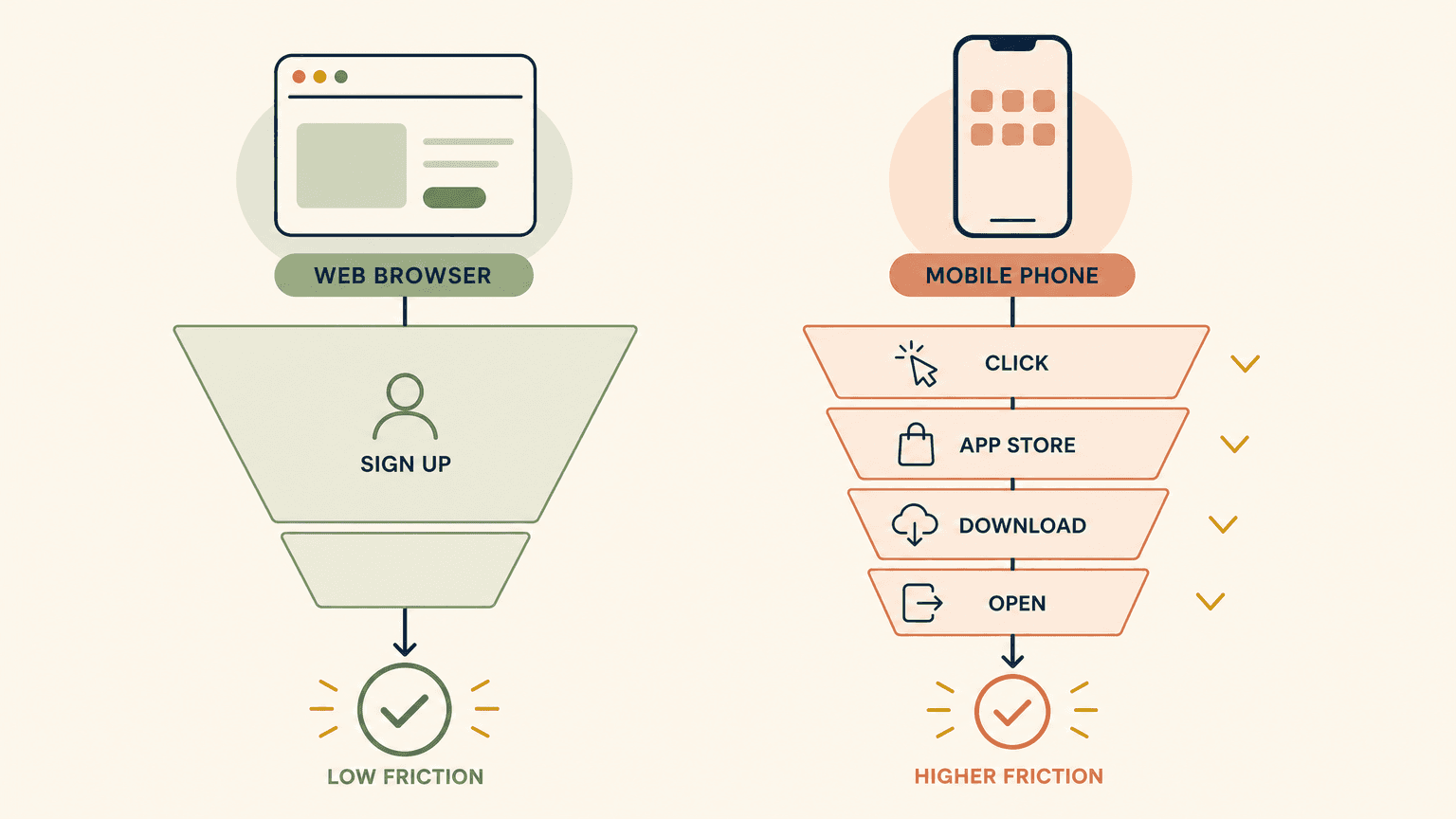
The iOS-specific catch matters most. Product Hunt's audience skews web and desktop (developers, designers, founders), and the PH mobile app only surfaces featured launches. So the path for your app is click, then App Store, then download, then open, which is far higher friction than the click-to-web-signup path a SaaS enjoys. Anecdotes are mixed: one maker reported solid App Store signups with zero ASO effort, another said driving native-app installs simply did not work. Treat Product Hunt as a web-traffic and credibility event first, an install driver second. For the broader channel picture, see the indie marketing strategy guide.
One rule that is not optional: Product Hunt prohibits vote solicitation and incentivized upvotes. Coordinated voting risks penalties.
When to launch: 12:01am PT, Tuesday or Wednesday
Product Hunt's day runs midnight to midnight Pacific. Launch at 12:01am PT to capture the full 24-hour ranking window.
Best days are Tuesday or Wednesday (some sources say Tuesday through Thursday) for the balance of engagement and competition. Avoid Monday, Friday, weekends, major holidays, and big tech-keynote days. Note that Tuesday is also the most competitive day, so it cuts both ways.
The iOS gate to plan around: your build must be approved and live on the App Store before 12:01am PT. App Review can take 24 to 48 hours, longer with a rejection, so never schedule a launch against an unapproved build. Get the app live first, then pick the launch date.
Velocity in the first hours matters more than the daily total. Community estimates suggest queuing 200+ first-hour supporters or aiming for 50+ upvotes in the first 6 hours. Treat those as directional.
The hunter myth is dead: self-hunting in 2026
For years the advice was to get a high-profile "hunter" to post your product. That advantage is gone.
As getlaunchlist puts it: "In 2025, Product Hunt reduced the weight given to top hunters. In 2026, self-hunting is usually fine." Self-launched products have reportedly made up the majority of daily top-5 finishes since around 2023, and there is no algorithmic boost from a third-party hunter. A hunter only helps if your own network is weak or you want first-time coaching.
One requirement: your maker account should be at least about a week old (some guides say active 30+ days) before you launch. Do not create an account and launch the same day.
The assets you need (and the App Store assets PH traffic lands on)
Prepare these before launch week (sources: producthunt.com/launch, pendium.ai):
- Product name.
- Tagline: one sentence under 60 characters, formula "Action Verb + Outcome + Time/Ease," for example "Automate your SEO in 30 seconds."
- Thumbnail: square, 240x240. Fewer than a third of Product-of-the-Day winners used an animated GIF, so a GIF is optional, not required.
- Gallery: minimum 2 images, recommended around 1270x760, ideally 5 to 7 high-fidelity mockups with the value prop in bold text on the first two.
- Maker first comment: 200 to 300 words covering the origin story, the problem solved, and a genuine question to spark discussion.
Here is the one place our tool fits, indirectly. Every PH click lands on your App Store product page, where visitors judge you on the first 2 to 3 screenshots. If that listing is weak, the traffic bounces. ScreenFast (our own AI App Store screenshot generator) audits the listing for free and generates 10 design directions after the $9.99 one-time checkout; it does not touch Product Hunt itself. See the AI App Store screenshot generator, and make sure the listing converts by checking conversion benchmarks.
How to launch on Product Hunt (official guide) covers the asset setup on screen.
How ranking actually works in 2026 (quality-weighted, comment-driven)
Product Hunt does not rank on raw upvotes. It ranks on a quality-weighted net upvote count.
Votes are weighted by voter account age, verification, and behavior. Diverse voting across many products looks organic; a flood of accounts that only voted for your product looks mobilized and gets discounted. Raw totals are periodically cleared (one source says roughly every two hours) as flagged spam accounts are removed, which is why a visible count can drop mid-launch.
Comment depth is a strong featuring signal. One framing: a launch with 700 upvotes and 80 quality comments can beat 1,000 upvotes with 12 comments. And there is an editorial gate: products must be Featured by human editors for significant visibility. An Indie Hackers report of 100 upvotes and 50+ comments but no feature translated to little traffic. The maker first comment also pulls weight: makers with strong first comments reportedly average 166% more upvotes, and about 70% of Product-of-the-Day winners had one (signals.sh figures, methodology not disclosed, treat as directional).
Realistic numbers: upvote thresholds and traffic, with honest hedging
The numbers vary so widely between sources that the spread is itself the lesson. Here is the range.
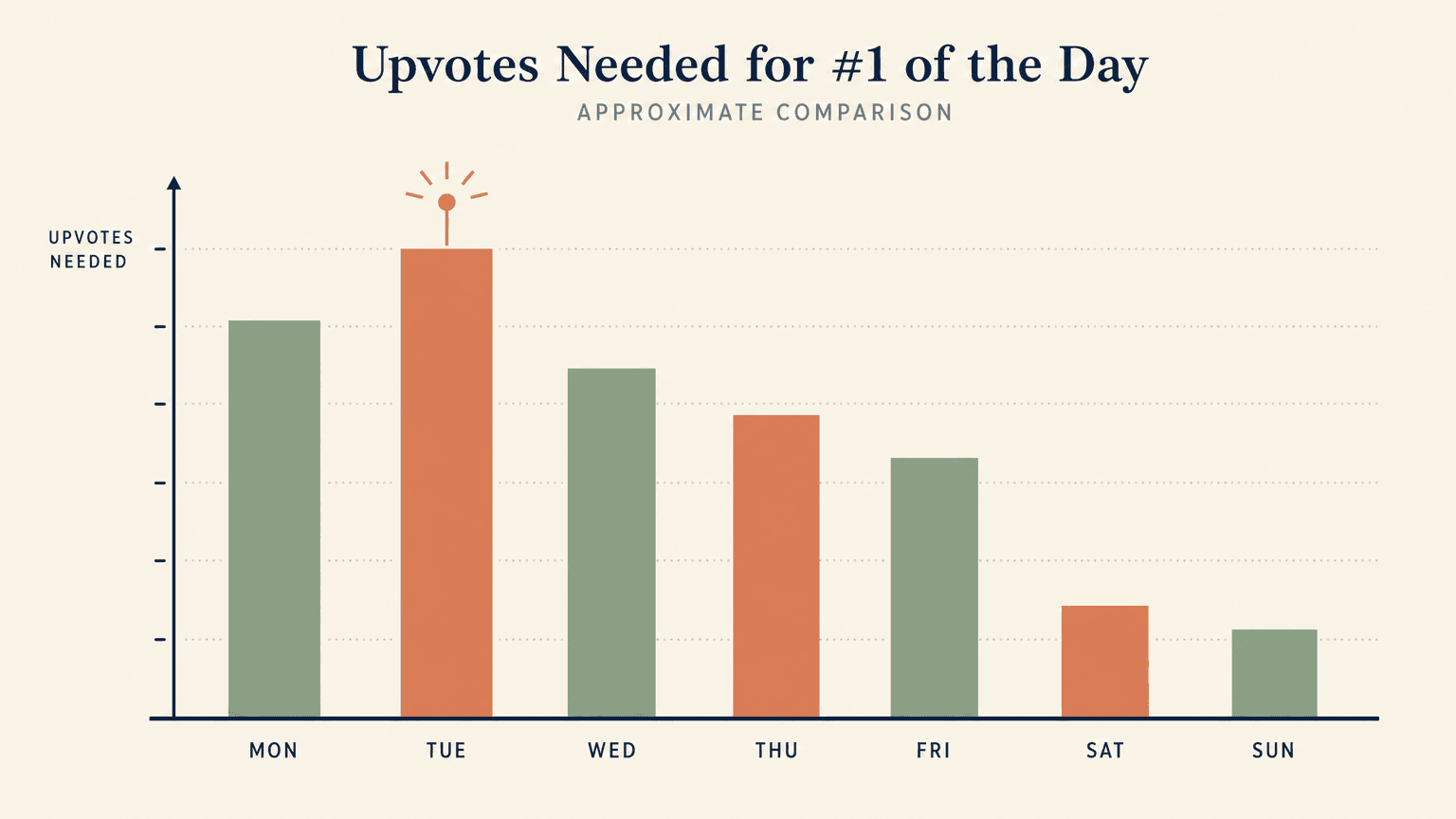
| Placement | signals.sh estimate | Other sources | Note |
|---|---|---|---|
| #1 of the Day (weekday) | Tue ~1,050, Wed ~1,000 net upvotes | getlaunchlist 500-1,200; tooljunction 800-1,200 (AI) | Wide spread; all estimates |
| Top 5 of the Day | velocity ~45-55 upvotes/hr weekday | innmind ~200-350 upvotes | Different metric per source |
| Product of the Week | ~1,500-2,000 cumulative | getlaunchlist: 50,000+ visitors | Cumulative, not single-day |
| Product of the Month | ~2,000-2,500 cumulative | n/a | Single source; cautious |
| First launch, no community | n/a | dev.to: 10+ good, 50+ with prep | Majority get 0-2 upvotes |
On traffic: getlaunchlist cites 5,000 to 50,000 visitors in 48 hours for strong launches, and 50,000+ for Product of the Week or Month, against 150,000 to 250,000 daily PH visitors. The dev.to survey's visitor distribution: about 24.5% of launches get 100 to 500 users, 26.5% get 500 to 1,000, 22.4% get 1,000 to 2,000. None of these are audited, so plan for the lower end.
Treat the launch as a 6-week project, not a day
The best launches reflect weeks of prep, with some founders citing 50 to 120+ hours and a 6-week timeline that includes a 4-week waitlist.
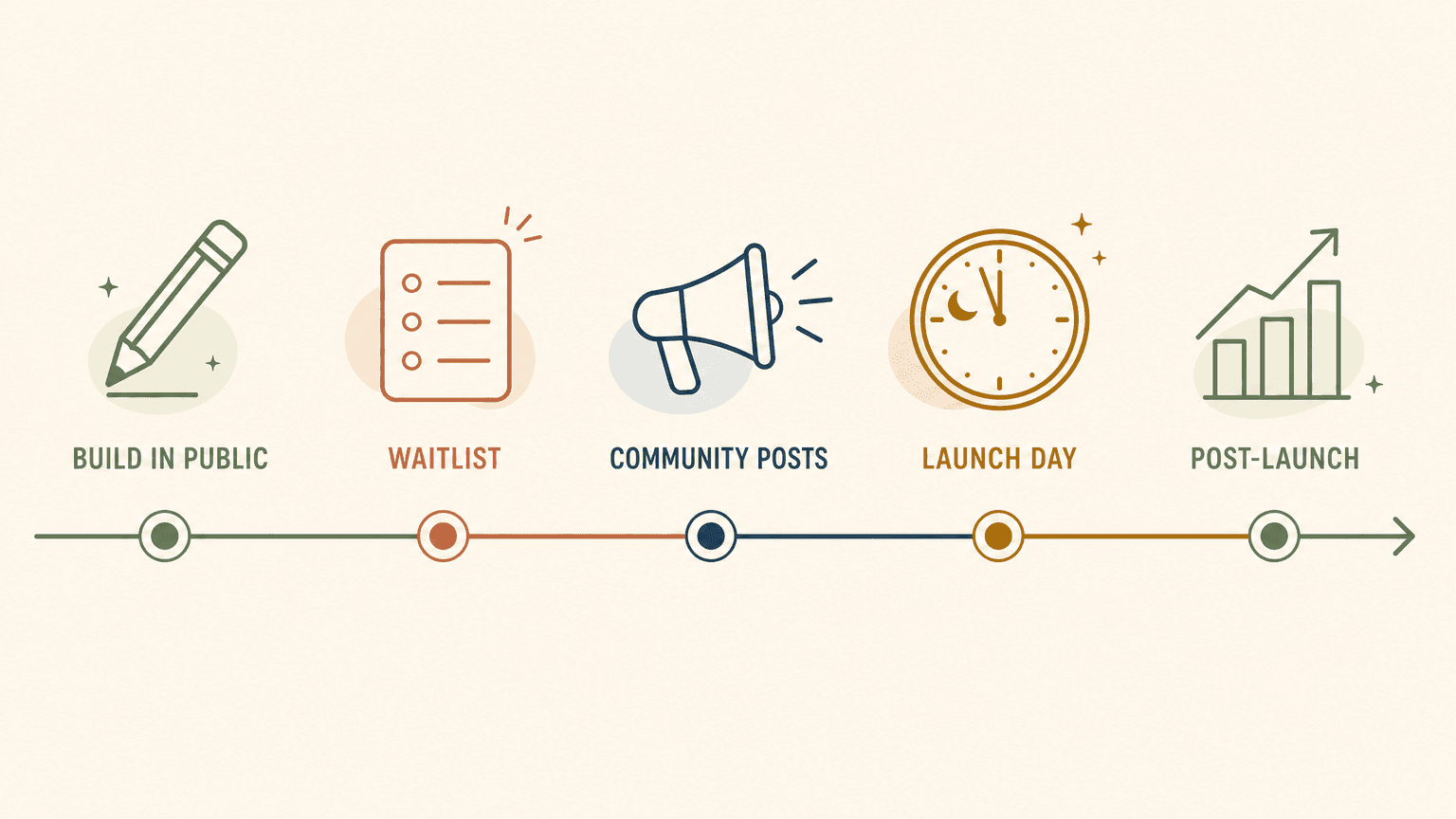
The Coming Soon page is the repeatedly-named secret weapon. Aim for 60%+ of your launch-day traffic to come from your own pre-built audience. A 4-week waitlist can yield 300 to 500 engaged signups and 200+ first-hour supporters, and Coming Soon follower-to-upvote conversion runs roughly 50 to 65%, so about 400 followers yields 175 to 200 net upvotes after clearing.
Build that audience with build-in-public threads, Indie Hackers and Reddit posts (see the Reddit playbook), weekly subscriber updates, and referral incentives. One honest reality check from the community: 1:1 outreach like LinkedIn DMs is high-ROI for votes, but a lot of that support comes from other founders, not real users.
How we tested
This synthesizes 2026 Product Hunt founder guides (signals.sh, getlaunchlist, poindeo, pendium.ai, tooljunction, innmind), Product Hunt's own launch documentation, and a dev.to outcomes survey. Apple specs are cited to developer.apple.com. The honest caveat: most upvote, traffic, and conversion figures are uncited third-party marketing-blog estimates that vary widely between sources, which is why we present ranges and label them as estimates. Claims we could not cleanly verify (such as exact vote-clearing intervals) are flagged as unconfirmed. ScreenFast is our own product, mentioned only at the indirect step where PH traffic meets your App Store listing.
FAQ
Can I launch on Product Hunt for free?
Yes. Launching is free. The cost is the weeks of prep and audience-building, not a listing fee.
Do I still need a hunter to launch in 2026?
No. Product Hunt reduced the weight of third-party hunters in 2025, and self-hunting is now the norm. A hunter only helps if your own network is weak.
How many upvotes do I need to be #1 of the day?
Estimates range from roughly 500 to 1,200+ depending on the day and source, with Tuesday the most competitive. Treat every number as an estimate; velocity in the first hours matters more than the total.
What time zone does Product Hunt use, and when should I launch?
Pacific Time. The day runs midnight to midnight PT, so launch at 12:01am PT, ideally Tuesday or Wednesday, to get the full 24-hour window.
Will a Product Hunt launch actually drive App Store installs?
Less reliably than web signups. PH's audience is desktop-heavy, and the click-to-App-Store-to-download path is high friction. Expect web traffic and credibility first, installs second.
Can I launch the same app on Product Hunt more than once?
Product Hunt allows relaunches for significant updates after a waiting period. Do not relaunch the same thing repeatedly; lead with a genuine new version or major feature.
How important is the maker's first comment?
Very. It is a featuring signal and reportedly correlates with far higher upvote counts. Write 200 to 300 words: the origin story, the problem, and a question that invites discussion.